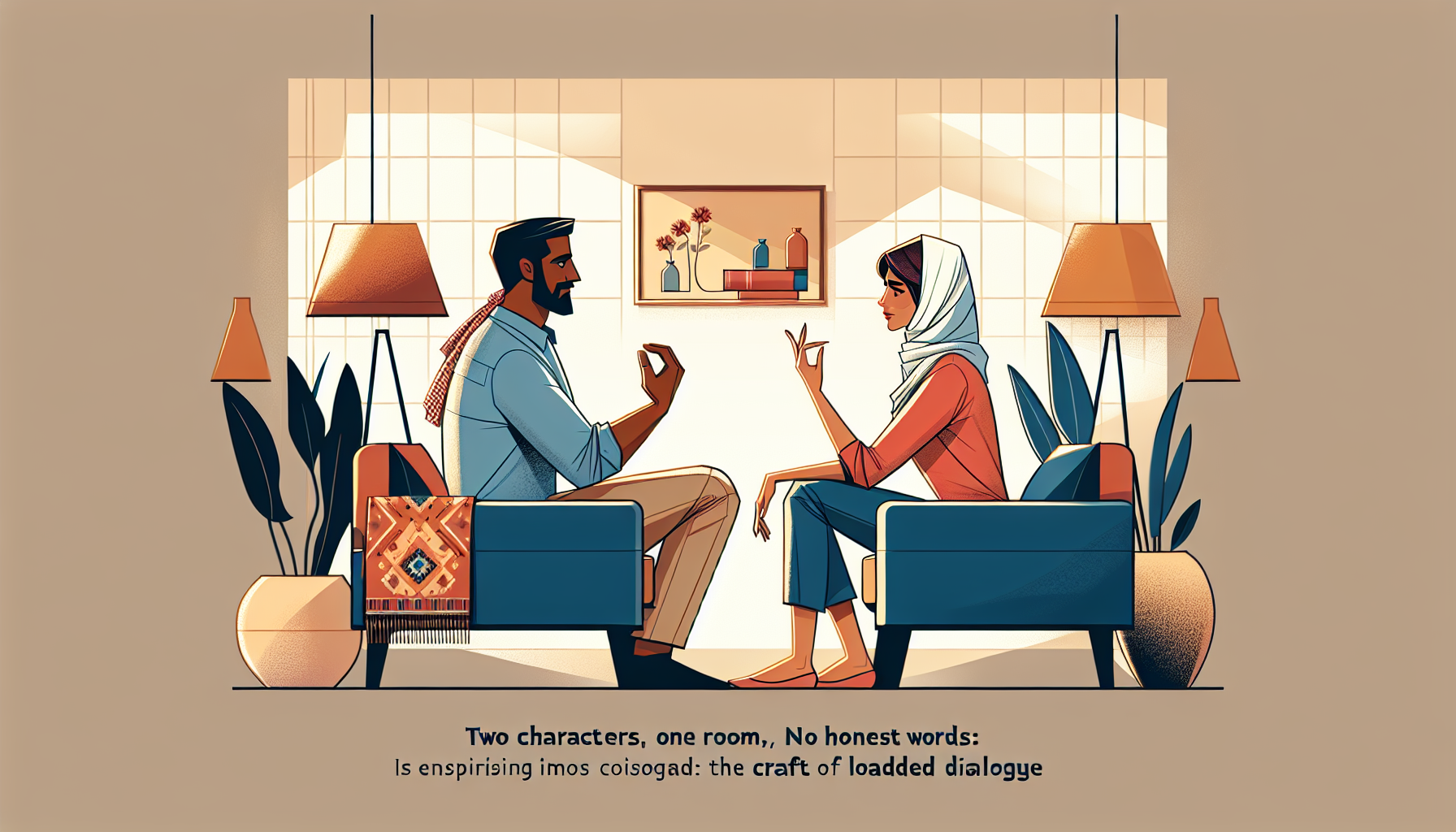
Put two characters in a kitchen and have them argue about whose turn it is to do the dishes. Now make one of them know the other has been lying for six months. Suddenly the dishes aren't about the dishes at all. That's subtext, and it's the engine behind almost every scene of dialogue that makes a reader hold their breath.
Most early drafts don't have this problem because writers are lazy. They have it because writers are generous. They want the reader to understand, so they write dialogue that explains. Characters say exactly what they feel, name the conflict directly, and close every loop. The scene is clear. It is also dead.
The Problem with On-the-Nose Lines
On-the-nose dialogue is any exchange where a character says precisely what they mean and feels. "I'm angry at you because you never support my ambitions." "I feel like you don't respect me." These lines aren't wrong, exactly. Real people say them. But in fiction, stating the emotional content of a scene removes the reader's job, and the reader's job is what keeps them engaged.
Here's a quick before-and-after to make this concrete.
On-the-nose version:
"You never come to my openings," she said. "It makes me feel like my work doesn't matter to you." "That's not true. I care about your work. I'm just busy."
Loaded version:
"The Hendersons asked about you," she said, not looking up from the sink. "What did you tell them?" "That you had a thing." He picked up his keys. "I did have a thing." "I know."
The second version doesn't explain what's wrong. It shows two people who have stopped trying to be understood. The reader feels the distance without being told it exists. That feeling is the point.
How Conflict Hides in Plain Speech
Subtext in fiction works because characters, like real people, protect themselves. They deflect, they change the subject, they answer a question with a question. When you write conflict into dialogue, your job is to figure out what each character wants in this moment, and then what they're willing to say to get it, or to avoid losing it.
A character who wants forgiveness might pick a fight about something small instead of asking for it. A character who is afraid might respond to every emotional overture with a practical observation. A character who feels guilty might become suddenly, aggressively helpful.
The technique is simple to describe: know the true want, then block the character from stating it directly. The gap between what they want and what they say is where subtext lives.
Topic changes are one of the most reliable tools here. When a character veers sharply away from what's being discussed, the reader notices. The other character in the scene might not acknowledge it, but the reader does. That gap does more emotional work than a paragraph of interiority.
Building Character Voice Through What Gets Left Out
Character voice in dialogue isn't only about vocabulary or sentence rhythm, though those matter. It's also about what a character refuses to say, or can't bring themselves to say, or doesn't have the words for yet. Voice is shaped by restraint as much as expression.
A grieving character might talk about logistics. A jealous one might ask too many clarifying questions. Someone who has been betrayed might become very polite. These aren't quirks; they're coping behaviors, and they tell the reader something true about the person without a single line of explanation.
If your characters all emote at the same temperature, with the same willingness to be direct, they'll start to blur together even if their word choices differ. Give each character a particular way of not saying things. One avoids eye contact by talking about the weather. Another responds to vulnerability with humor. Another goes quiet and lets silence do the work. These habits, kept consistent, are more distinctive than any amount of distinctive slang.
Working Out What a Scene Is Really About
This is where a lot of writers get stuck. They know a scene should have subtext. They just can't figure out what's underneath the surface conversation, because they haven't fully worked out what each character is carrying into the room.
This is exactly where Nexa, Writing Nexus's in-app story coach, is useful. Nexa works like a developmental editor focused on your specific project: you describe your scene, your characters, and what you're trying to accomplish, and she helps you think through the underlying conflict, the emotional stakes, and what each character would and wouldn't say given where they are in the story. She doesn't write the scene for you. She helps you figure out what it needs to be before you write it, which is a different and more valuable thing. If you're staring at a dialogue scene that feels flat and you can't diagnose why, working through it with Nexa can surface the real problem faster than another pass at the prose.
A Few Habits Worth Building
When you're revising a dialogue scene, try reading each character's lines in isolation. Ask: does this character ever say what they actually want? If yes, every time, that's a problem. Then look for places where a character answers a question they weren't asked, or avoids answering the question they were. Those moments are your subtext opportunities.
Also watch for emotional labeling in dialogue tags and beats. "She said, feeling hurt" or "he replied, his anger rising" are the prose equivalent of on-the-nose lines. If the dialogue is doing its job, you shouldn't need to name the feeling in the surrounding text.
One more thing: silence is dialogue. A beat where a character doesn't answer, looks away, or picks up an object and puts it down again can carry as much weight as three lines of speech. Don't fill every pause.
The conversations that stay with readers are the ones where something was never quite said. Two characters circling the thing neither of them can name, getting closer and then retreating. That tension, held long enough, is what makes a scene feel real.
If you want to pressure-test your own dialogue scenes before you draft them, try Writing Nexus and work with Nexa. Bring a scene that's been giving you trouble and see what's actually underneath it.